What is Density?

Density describes how much mass is packed into a given volume of a substance.
Two objects may have the same size but different masses because they are made from materials with different densities. Similarly, two objects with the same mass may occupy different volumes.
For example, a metal block usually feels heavier than a wooden block of the same size because metal generally has a greater density than wood.
Mass, Volume and Density
Density depends on two quantities:
- Mass – the amount of matter in an object
- Volume – the amount of space occupied by the object
A material has a high density when a relatively large mass is packed into a small volume.
A material has a low density when the same volume contains less mass.
Formula for Density
Density is calculated by dividing mass by volume.
 Using symbols:
ρ=Vm
where:
- ρ represents density
- m represents mass
- V represents volume
Units of Density
The SI unit of density is:
kilogram per cubic metre (kg/m³)
Another commonly used unit is:
gram per cubic centimetre (g/cm³)
The unit used depends on the size of the object and the measurements being made.
Calculating Density
As defined above,

Suppose an object has a mass of 200 g and a volume of 100 cm³.
Its density is:
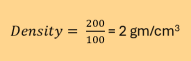
This means that every cubic centimeter of the material has a mass of 2 grams.
Calculating Mass from Density
If density and volume are known, mass can be calculated using:
Mass=Density×Volume
For example, if a material has a density of 3 g/cm³ and a volume of 20 cm³:
Mass=3×20=60 g
Calculating Volume from Density
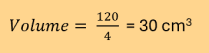
If mass and density are known:
 For example, an object with a mass of 120 g and a density of 4 g/cm³ has a volume of:
Density and Particle Arrangement
Density can be understood using the particle model of matter.
When particles are packed closely together, more mass may be contained within a given volume.
When particles are farther apart, the same volume may contain less mass.
However, density also depends on the mass of the individual particles, so particle spacing alone does not completely determine density.
Density of Solids
Many solids have relatively high densities because their particles are packed closely together.
Different solid materials can have very different densities.
For example, a metal object may be much heavier than a wooden or plastic object of the same size.
Density is an important property used to identify and compare materials.
Density of Liquids
Liquids also have different densities.
When liquids that do not mix are placed together, the less dense liquid tends to form a layer above the denser liquid.
Oil commonly floats on water because oil is generally less dense than water.
This principle can be demonstrated by placing liquids of different densities in the same container.
Density of Gases
Gases generally have much lower densities than solids and liquids because their particles are much farther apart.
Different gases also have different densities.
Helium is less dense than ordinary air, which is why a helium-filled balloon rises.
The density of a gas can change considerably when its temperature or pressure changes.
Density and Temperature
The density of many substances changes with temperature.
When most materials are heated, they expand. Their mass remains approximately the same, but their volume increases.
Since density is mass divided by volume, an increase in volume generally causes density to decrease.
Cooling usually causes materials to contract and become denser.
Density and Pressure
Pressure can affect density, particularly in gases.
When a gas is compressed, its particles are forced closer together. The same mass occupies a smaller volume, so the density increases.
Liquids and solids are much less compressible, so ordinary pressure changes usually have a smaller effect on their density.
Density of Water
Water has an unusual density behaviour.
Most substances become steadily denser as they cool. Water reaches its greatest density at about 4°C.
When water freezes, its particles form a more open structure. Ice therefore has a lower density than liquid water.
This is why ice floats.
Floating and Sinking
Density helps determine whether an object will float or sink in a fluid.
In simple terms:
- an object less dense than the surrounding fluid tends to float
- an object more dense than the surrounding fluid tends to sink
- an object with the same average density as the fluid may remain suspended
Floating also involves the buoyant force exerted by the fluid.
Why Do Ships Float?
Ships are often made mainly from materials such as steel, which is denser than water.
However, a ship is hollow and contains a large volume of air.
The mass of the entire ship is therefore spread over a much larger volume, reducing its average density.
When the ship’s average density is low enough, it can float on water.
Measuring the Density of a Regular Solid
To find the density of a regularly shaped solid:
- Measure its mass using a balance.
- Measure its dimensions.
- Calculate its volume using the appropriate geometrical formula.
- Divide the mass by the volume.
For a rectangular block:
V=l×w×h
The density can then be calculated using:
ρ=Vm
Measuring the Density of an Irregular Solid
The volume of an irregular solid cannot always be found easily using dimensions.
Instead, its volume can be measured using water displacement.
The object is placed completely under water in a measuring cylinder.
The increase in water volume is equal to the volume of the object.
Its mass is measured separately, and density is then calculated.
Measuring the Density of a Liquid
To measure the density of a liquid:
- Measure the mass of an empty container.
- Add a known volume of the liquid.
- Measure the combined mass.
- Subtract the mass of the empty container to obtain the mass of the liquid.
- Divide the mass of the liquid by its volume.
This gives the density of the liquid.
Relative Density
Relative density compares the density of a substance with the density of a reference substance, usually water for solids and liquids.
It is calculated as:

Relative density has no unit because it is a ratio of two densities measured in the same units.
A relative density below 1 generally indicates that the substance is less dense than water.
Density and Material Identification
Density is a characteristic physical property of a material.
Measuring density can therefore help identify an unknown substance.
For example, if the measured density of a metal sample closely matches the known density of aluminium, copper, or another metal, it provides evidence about the material’s identity.
Density alone may not always be sufficient, so other properties can also be considered.
Applications of Density
Density is important in many areas of science, engineering, and everyday life.
Applications include:
- designing ships and submarines
- separating liquids
- identifying materials
- designing hot-air and helium balloons
- studying the atmosphere
- checking the quality or concentration of liquids
- geology and mineral identification
- engineering and construction
Density in Everyday Life
We encounter density in many familiar situations.
Examples include:
- ice floating in a drink
- oil floating on water
- balloons rising through air
- objects floating or sinking in water
- cream forming above milk
- layered liquids in containers
- ships floating despite being made from metal
Understanding density helps explain why these apparently different events occur.
Key Points
- Density describes the mass contained in a given volume.
- Density is calculated by dividing mass by volume.
- The SI unit of density is kg/m³.
- Different substances have different densities.
- Density depends on both particle arrangement and particle mass.
- Heating usually decreases density because materials expand.
- Gases are generally much less dense than solids and liquids.
- Ice is less dense than liquid water and therefore floats.
- Density helps determine whether an object floats or sinks.
- The density of regular solids, irregular solids, and liquids can be measured experimentally.
- Density is useful for identifying materials and explaining many everyday phenomena.
Glossary of Key Terms
Recap of the Key Terms in Density
- Average Density: The total mass of an object divided by its total volume.
- Buoyant Force: The upward force exerted by a fluid on an object placed in it.
- Density: The amount of mass contained in a given volume of a substance.
- Float: To remain on or near the surface of a fluid because the object is less dense than the fluid or is supported by sufficient buoyant force.
- Gram per Cubic Centimetre (g/cm³): A commonly used unit of density.
- Kilogram per Cubic Metre (kg/m³): The SI unit of density.
- Mass: The amount of matter in an object.
- Relative Density: The ratio of the density of a substance to the density of a reference substance, usually water for solids and liquids.
- Sink: To move downward through a fluid because the object is denser than the fluid and its weight is greater than the buoyant force.
- Volume: The amount of space occupied by an object or substance.
- Water Displacement: A method of finding the volume of an irregular object by measuring how much the water level rises when the object is submerged.
Questions and Answers
Recap the concepts you have learnt. Try to answer the questions. You can find the answer to any question by clicking on the icon.
What is density?
Density is the amount of mass contained in a given volume of a substance.
What is the formula for density?
Density is calculated by dividing mass by volume.
What symbol is commonly used for density?
The Greek letter rho, ρ, is commonly used for density.
What is the SI unit of density?
The SI unit of density is kilogram per cubic metre, kg/m³.
What is another commonly used unit of density?
Gram per cubic centimetre, g/cm³, is also commonly used.
What does a high-density material mean?
It means a relatively large mass is packed into a given volume.
What does a low-density material mean?
It means a smaller mass is contained in the same volume.
Can two objects of the same size have different masses?
Yes. If they are made from materials with different densities, their masses can be different.
Can two objects with the same mass have different volumes?
Yes. Materials with different densities can occupy different volumes even when their masses are the same.
Why is a metal block usually heavier than a wooden block of the same size?
Metal generally has a greater density than wood.
How is mass calculated when density and volume are known?
Mass is calculated by multiplying density by volume.
How is volume calculated when mass and density are known?
Volume is calculated by dividing mass by density.
How does particle arrangement affect density?
Particles packed more closely together can contribute to a greater density.
Does particle spacing alone determine density?
No. Density also depends on the mass of the individual particles.
Why do many solids have relatively high densities?
Their particles are usually packed closely together.
Why are gases generally less dense than solids and liquids?
Gas particles are much farther apart.
Why does oil usually float on water?
Oil is generally less dense than water.
Why does helium rise in air?
Helium is less dense than air.
How does heating usually affect density?
Heating usually causes a material to expand, increasing its volume and decreasing its density.
How does cooling usually affect density?
Cooling usually causes a material to contract, decreasing its volume and increasing its density.
How does pressure affect the density of a gas?
Increasing pressure compresses the gas, reducing its volume and increasing its density.
Why does pressure have less effect on the density of solids and liquids?
Solids and liquids are much less compressible than gases.
At approximately what temperature is water most dense?
Water is most dense at about 4°C.
Why does ice float on water?
Ice is less dense than liquid water.
What usually happens when an object is less dense than the fluid around it?
It tends to float.
What usually happens when an object is more dense than the fluid around it?
It tends to sink.
What may happen when an object has the same average density as the surrounding fluid?
It may remain suspended in the fluid.
Why can a steel ship float even though steel is denser than water?
The ship is hollow, so its total mass is spread over a large volume, giving it a lower average density.
How do you measure the density of a regular solid?
Measure its mass, calculate its volume from its dimensions, and divide mass by volume.
How can the volume of an irregular solid be measured?
Its volume can be measured using water displacement.
What does the rise in water level represent when an irregular object is submerged?
It represents the volume of the object.
How is the density of a liquid measured?
Measure the mass of a known volume of the liquid and divide the mass by the volume.
What is relative density?
Relative density compares the density of a substance with the density of a reference substance.
Does relative density have a unit?
No. It is a ratio, so it has no unit.
What does a relative density less than 1 usually mean?
It means the substance is less dense than water.
Can density help identify a material?
Yes. Density is a characteristic physical property and can help identify an unknown material.
Why might density alone not be enough to identify a substance?
Different materials may have similar densities, so other properties may also need to be considered.
Give one everyday example involving density.
Ice floating in water is an everyday example of density.
39. Give one engineering application of density.
Density is important when designing ships and submarines.
40. Why is density useful in science and everyday life?
It helps explain floating, sinking, material identification, fluid layering, and many other physical behaviours.
Give one engineering application of density.
Density is important when designing ships and submarines.
Why is density useful in science and everyday life?
It helps explain floating, sinking, material identification, fluid layering, and many other physical behaviours.