Topics
What is Pressure?

Pressure describes how a force is distributed over an area on a surface.
The same force can produce very different effects depending on the area over which it acts. A force applied over a small area produces greater pressure than the same force spread over a larger area.
This is why a sharp knife cuts more easily than a blunt one, and why wide tyres or snowshoes help prevent sinking into soft ground.
Force, Area and Pressure
Pressure depends on two quantities:
- Force – the push or pull acting on a surface
- Area – the surface area over which the force acts
Pressure increases when:
- the force increases
- the same force acts over a smaller area
Pressure decreases when:
- the force decreases
- the same force is spread over a larger area
Formula for Pressure
Pressure is calculated using:

Using symbols:
 where:
- P represents pressure
- F represents force
- A represents area
Unit of Pressure
The SI unit of pressure is pascal (Pa).
One pascal is equal to one newton of force acting over an area of one square metre.

Larger pressures may be expressed in kilopascals (kPa) or megapascals (MPa).
Calculating Pressure
Suppose a force of 100 N acts over an area of 2 m².

The pressure is therefore 50 Pa.
Calculating Force from Pressure
If pressure and area are known:
F=P × A
For example, if a pressure of 200 Pa acts over an area of 3 m²:
F=200 × 3 = 600 N
Calculating Area from Pressure
If force and pressure are known:
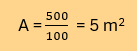
 For example, if a force of 500 N produces a pressure of 100 Pa:
Pressure and Surface Area
For the same force, decreasing the contact area increases pressure.
This principle explains many familiar examples.
- A sharp needle pierces material easily because the force acts over a very small area.
- A sharp knife cuts better than a blunt knife.
- High-heeled shoes exert greater pressure on the floor than flat shoes.
- Wide tractor tyres spread the vehicle’s weight over a larger area and reduce pressure on soft ground.
- Snowshoes reduce pressure on snow and help prevent a person from sinking deeply.
Pressure in Solids
A solid exerts pressure on the surface supporting it because of its weight.
The pressure depends on:
- the weight of the object
- the area of contact with the surface
The same object can exert different pressures depending on which face rests on the surface.
For example, a rectangular block standing on its smallest face produces greater pressure than when resting on its largest face.
Pressure in Liquids
Liquids exert pressure on the surfaces with which they are in contact.
Liquid pressure acts in all directions.
Pressure in a liquid increases with depth because lower layers support the weight of the liquid above them.
This is why:
- water pressure is greater near the bottom of a tank
- dams are thicker near their base
- divers experience greater pressure at greater depths
Factors Affecting Liquid Pressure
The pressure in a liquid depends mainly on:
- depth below the surface
- density of the liquid
- gravitational field strength
A denser liquid produces greater pressure at the same depth than a less dense liquid.
Pressure in Gases
Gases also exert pressure.
Gas particles move rapidly and randomly. When they collide with the walls of their container, they exert forces on those walls.
The combined effect of many collisions produces gas pressure.
Gas pressure acts in all directions.
Effect of Temperature on Gas Pressure
When a gas in a fixed container is heated, its particles gain kinetic energy and move faster.
They collide with the walls more frequently and more forcefully, causing the pressure to increase.
Cooling the gas generally reduces the pressure because the particles move more slowly.
Effect of Volume on Gas Pressure
When a gas is compressed into a smaller volume, its particles have less space in which to move.
They strike the container walls more frequently, so the pressure increases.
Increasing the volume allows the particles to spread out, reducing the frequency of collisions and lowering the pressure.
Atmospheric Pressure
The air surrounding Earth has mass and exerts pressure.
This pressure is called atmospheric pressure.
Atmospheric pressure acts in all directions, even though we usually do not notice it because the pressure inside our bodies helps balance the pressure outside.
Atmospheric Pressure and Altitude
Atmospheric pressure decreases with increasing altitude.
At higher altitudes, there is less air above a given point, so the weight of the atmosphere pressing downward is smaller.
This is why air pressure is lower on mountains than at sea level.
Measuring Atmospheric Pressure
Atmospheric pressure can be measured using a barometer.
Changes in atmospheric pressure can also provide information about weather.
High-pressure systems are often associated with more settled weather, while low-pressure systems are often associated with clouds, wind, or rain.
Pressure in Hydraulic Systems
Liquids are nearly incompressible and can transmit pressure effectively.
When pressure is applied to a confined liquid, it is transmitted throughout the liquid.
This principle is used in hydraulic systems such as:
- hydraulic brakes
- hydraulic jacks
- hydraulic lifts
- excavators
- heavy machinery
Hydraulic systems allow relatively small forces to produce larger useful forces.
Pressure in the Human Body
Pressure is also important in biological systems.
Blood pressure helps move blood through blood vessels.
Air pressure changes during breathing help move air into and out of the lungs.
Pressure differences also affect the ears when travelling in aircraft, climbing mountains, or diving underwater.
Pressure and Floating
Pressure in a fluid contributes to the buoyant force acting on an object.
Fluid pressure is greater at greater depths. Therefore, the pressure on the bottom of a submerged object is usually greater than the pressure on its top.
This difference in pressure produces an upward force called buoyant force or upthrust.
Pressure in Everyday Life
Pressure is involved in many everyday situations.
Examples include:
- cutting with knives
- using needles and pins
- drinking through a straw
- inflating tyres
- using pressure cookers
- hydraulic brakes in vehicles
- water flowing from taps
- air pressure in footballs and balloons
- walking on snow or soft ground
- weather changes caused by atmospheric pressure
Applications of Pressure
Understanding pressure is important in engineering, medicine, transport, construction, meteorology, and everyday life.
Applications include:
- designing dams
- controlling tyre pressure
- hydraulic machinery
- measuring blood pressure
- weather forecasting
- designing aircraft and submarines
- pressure vessels and pipelines
- pumps and compressors
Safety and Pressure
High pressures can be dangerous.
Pressurised containers, gas cylinders, boilers, tyres, and hydraulic systems must be designed and handled carefully.
Excessive pressure may cause containers or components to fail.
Pressure equipment should therefore be used according to its specified limits and safety instructions.
Key Points
- Pressure is force acting per unit area.
- Pressure is calculated using P=F/A.
- The SI unit of pressure is the pascal.
- A smaller contact area produces greater pressure for the same force.
- Solids exert pressure on supporting surfaces.
- Liquids and gases exert pressure in all directions.
- Liquid pressure increases with depth and density.
- Gas pressure results from particle collisions.
- Atmospheric pressure decreases with altitude.
- Pressure can be transmitted through liquids in hydraulic systems.
- Pressure differences contribute to buoyancy.
- Pressure has many applications in daily life, technology, medicine, and engineering.
Glossary of Key Terms
Recap of the Key Terms in Pressure
- Area: The amount of surface over which a force acts.
- Atmospheric Pressure: The pressure exerted by the air surrounding Earth.
- Barometer: An instrument used to measure atmospheric pressure.
- Buoyant Force: The upward force exerted by a fluid on an object placed in it.
- Force: A push or pull that can change the motion or shape of an object.
- Gas Pressure: The pressure produced when gas particles collide with the walls of their container.
- Hydraulic System: A system that uses pressure transmitted through a liquid to produce or transfer force.
- Liquid Pressure: The pressure exerted by a liquid on surfaces in contact with it.
- Pascal (Pa): The SI unit of pressure, equal to one newton per square metre.
- Pressure: The force acting over a unit area of a surface.
- Pressure Difference: A difference in pressure between two regions that can cause fluids to move or produce forces.
- Pressure Vessel: A container designed to hold gases or liquids at pressures different from the surrounding pressure.
- Surface Area: The area of the surface over which a force is distributed.
- Upthrust: Another term for buoyant force.
Questions and Answers
Recap the concepts you have learnt. Try to answer the questions. You can find the answer to any question by clicking on the icon.
What is pressure?
Pressure is the force acting over a unit area of a surface.
What is the formula for pressure?
Pressure is calculated by dividing force by area.
What symbol is used for pressure?
The symbol P is commonly used for pressure.
What is the SI unit of pressure?
The SI unit of pressure is the pascal, Pa.
What is one pascal equal to?
One pascal is equal to one newton per square metre.
How does increasing force affect pressure?
For the same area, increasing force increases pressure.
How does increasing area affect pressure?
For the same force, increasing the area decreases pressure.
Why does a sharp knife cut more easily than a blunt knife?
A sharp knife applies the force over a smaller area, producing greater pressure.
Why do wide tyres reduce pressure on soft ground?
They spread the vehicle’s weight over a larger area.
Why do snowshoes help prevent a person from sinking into snow?
They increase the contact area and reduce the pressure on the snow.
How is force calculated when pressure and area are known?
Force is calculated by multiplying pressure by area.
How is area calculated when force and pressure are known?
Area is calculated by dividing force by pressure.
What causes a solid to exert pressure on a surface?
A solid exerts pressure because of its weight acting on the supporting surface.
Can the same solid exert different pressures?
Yes. It can exert different pressures depending on the area of contact.
When does a rectangular block exert the greatest pressure?
It exerts the greatest pressure when resting on its smallest face.
Do liquids exert pressure?
Yes. Liquids exert pressure on surfaces in contact with them.
In which directions does liquid pressure act?
Liquid pressure acts in all directions.
How does liquid pressure change with depth?
Liquid pressure increases as depth increases.
Why is water pressure greater near the bottom of a tank?
The lower layers support the weight of more liquid above them.
Why are dams thicker near their base?
They must withstand the greater water pressure at greater depths.
What factors affect pressure in a liquid?
Depth, liquid density, and gravitational field strength affect liquid pressure.
How does liquid density affect pressure?
At the same depth, a denser liquid produces greater pressure.
Do gases exert pressure?
Yes. Gases exert pressure on the walls of their container.
What causes gas pressure?
Gas pressure is caused by gas particles colliding with the walls of their container.
In which directions does gas pressure act?
Gas pressure acts in all directions.
What happens to gas pressure when a gas in a fixed container is heated?
The pressure increases because the particles move faster and collide more forcefully with the walls.
What happens to gas pressure when the volume of a gas is reduced?
The pressure increases because the particles collide with the walls more frequently.
What is atmospheric pressure?
Atmospheric pressure is the pressure exerted by the air surrounding Earth.
How does atmospheric pressure change with altitude?
Atmospheric pressure decreases as altitude increases.
Why is atmospheric pressure lower on mountains?
There is less air above a point at higher altitude.
What instrument is used to measure atmospheric pressure?
A barometer is used to measure atmospheric pressure.
How can atmospheric pressure be useful in weather forecasting?
Changes in atmospheric pressure can indicate changes in weather conditions.
What happens when pressure is applied to a confined liquid?
The pressure is transmitted throughout the liquid.
Give two examples of hydraulic systems.
Hydraulic brakes and hydraulic lifts are examples.
Why are liquids useful in hydraulic systems?
Liquids are nearly incompressible and transmit pressure effectively.
Why is pressure important in science and technology?
Buoyant force is the upward force exerted by a fluid on an object.
Why must pressurised containers be handled carefully?
Pressure is usually greater on the lower part of a submerged object than on the upper part, producing an upward force.
Give two everyday examples involving pressure.
Cutting with a knife and inflating a tyre are everyday examples involving pressure.
How does pressure contribute to buoyancy?
Excessive pressure can cause containers or components to fail.
What is buoyant force?
Pressure is important in areas such as hydraulics, weather forecasting, medicine, transport, construction, and engineering.