Laboratory and Reference

What are Laboratory and Reference Resources?
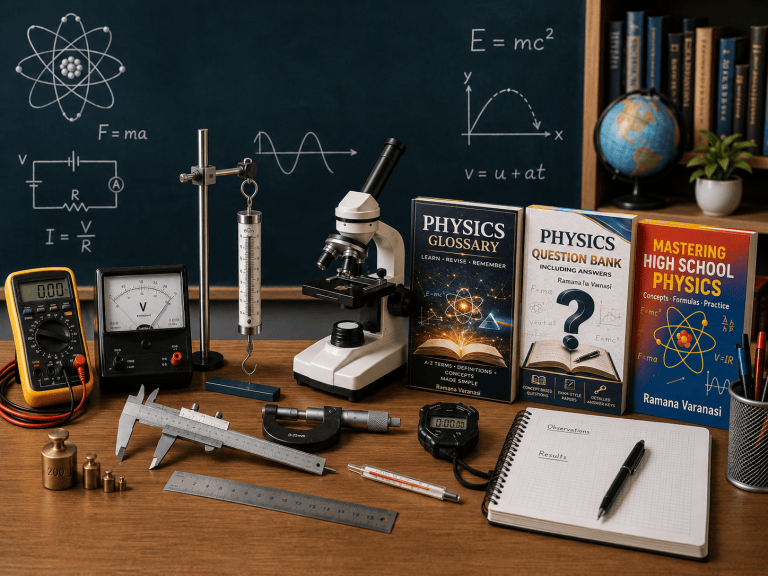
Physics laboratory and reference books, measurement tools, and physics reference books for learning

Laboratory and Reference resources support the study of Physics by providing practical tools, clear explanations, revision material, and opportunities to apply scientific concepts.

Physics involves more than learning concepts. It also requires observing, measuring, experimenting, recording results, solving problems, and revising important ideas.

This chapter introduces laboratory instruments, Physics books, and study resources that help learners develop practical skills, strengthen their understanding, and prepare for examinations.

Physics Laboratory Instruments

Physics laboratory instruments are used to observe phenomena and measure physical quantities accurately.

Different instruments measure quantities such as length, mass, time, temperature, force, electric current, and voltage. Examples include metre scales, vernier callipers, screw gauges, stopwatches, thermometers, spring balances, ammeters, and voltmeters.

Understanding how these instruments work helps students perform experiments correctly, take accurate readings, and record reliable observations.

Learn more about Physics Laboratory Instruments

Physics Books

Physics books provide explanations, examples, formulas, diagrams, and practice questions for learning and revision.

They help students understand difficult concepts, strengthen problem-solving skills, and review important topics at their own pace.

This section includes books and learning resources designed to support school-level Physics study and examination preparation.

Learn more about Physics Books

Mastering High School Physics

Mastering High School Physics is a concise study and revision guide for school-level Physics.

It brings together important concepts, formulas, definitions, and practice questions in a structured and easy-to-follow format.

The book is useful for quick revision, improving conceptual clarity, and preparing for school examinations.

Learn more about Mastering High School Physics